
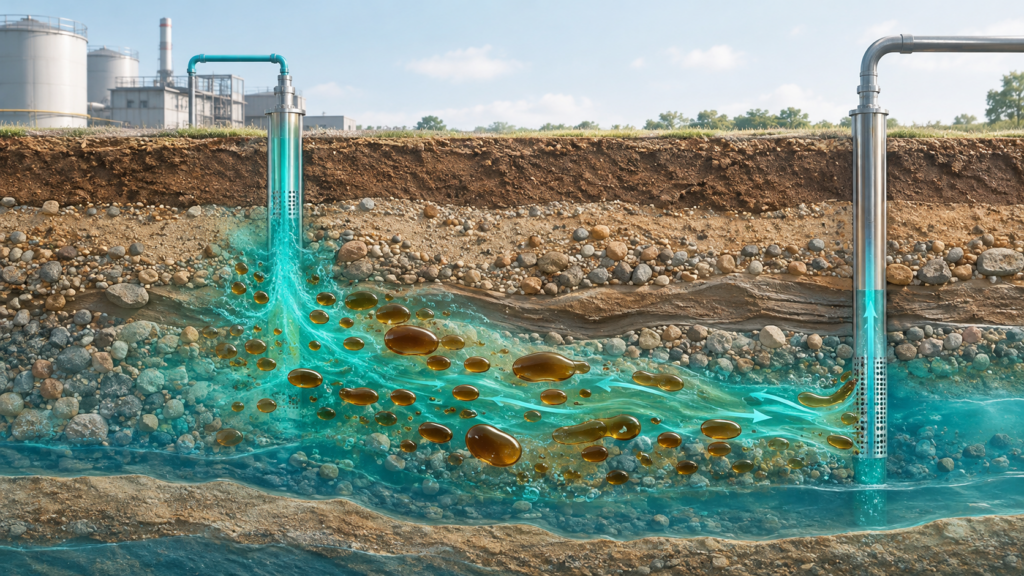
SEAR and TASK™ Technology: Mobilizing NAPL for More Effective Aquifer Remediation
Surfactant-Enhanced Aquifer Remediation (SEAR) was developed precisely to overcome this limit. In this article we look at how TASK™ (Tersus Advanced Surface Kinetics) works, the technology developed by Tersus Environmental and distributed in Italy by DeltaNova.
What Is TASK™
TASK™ is an advanced surfactant formulation that mobilizes NAPL and enhances its recovery from the subsurface. Its chemistries are rooted in a deep understanding of microemulsion science and capillary phenomena, the result of nearly two decades of research and testing at the University of Oklahoma.
The force that prevents NAPL from moving inside an aquifer is the capillary force, which comes from the high energy of the interface between oil and water. Lowering this energy frees the contaminant and makes it recoverable.
A Formulation Tailored to Every Site
No two contaminated sites are the same. That is why Tersus develops each formulation starting from actual site samples: NAPL, groundwater and soil. Laboratory testing focuses on three goals:
- Minimal interfacial tension: minimizing the oil–water interfacial tension, the force that holds NAPL in the soil pores.
- Middle-phase microemulsions: forming middle-phase microemulsions, the optimal condition for NAPL mobilization.
- Fast-breaking emulsions: designing emulsions that separate easily and simplify treatment of the extracted fluids.
Mobilization vs. Solubilization: the Difference That Matters
Many SEAR surfactants on the market work by solubilization: they dissolve the contaminant into the water and create an oily water that is difficult to treat above ground. This mechanism also typically requires a volume of surfactant greater than the volume of NAPL to be removed, which makes it expensive.
TASK™ formulations take a different approach: they create a middle-phase microemulsion that mobilizes the NAPL, so it can be moved and pumped to the surface as a separate phase. The resulting emulsions break spontaneously, in many cases eliminating the need for chemical additives or for disposing of large volumes of contaminated water.
The result: more NAPL recovered, less surfactant used and a waste stream that is easier to manage.
The Advantages of TASK™
- Ultra-low interfacial tension: for maximum NAPL recovery.
- Fast-breaking emulsions: that simplify treatment.
- Reduced surfactant use: often as low as 0.9% by weight.
- Lower waste disposal volumes.
- Greater opportunity to recycle the recovered NAPL.
An approach that combines effectiveness, sustainability and scientific rigor, with excellent cost-effectiveness.
Assess the Feasibility for Your Site
Every remediation project starts with a good understanding of the site. Together with the Tersus technical team, DeltaNova can support you in assessing the feasibility of SEAR and other in situ remediation technologies.
To get started, gather the key information about your site: contaminant type, analytical data, maps, stratigraphy and boring logs. We will help you understand which approach best fits your case.
Conclusion: a Tailored Solution
When the contaminant is present as a separate phase, pumping more water is not enough: you need to act on the forces that hold it in the subsurface.
With TASK™, SEAR becomes a targeted solution, built around the real characteristics of each site.
Recommended external links
- Tersus – Formulating Effective Surfactant Blends
– technical deep dive on TASK™ formulations - CLU-IN (EPA Clean Up Information)
– portal on remediation technologies and case studies

